Delve into the heart of the KarateFlow. Our journey is one of passion, discipline, and commitment.
"Karate is like boiling water; if you do not give it heat constantly, it will cool." - Gichin Funakoshi
Shao Kano Martial Arts Club is a premier institution for martial arts excellence. We promote, regulate, and develop Karate across all levels, ensuring quality training and standardized practices for every student.
Our club organizes belt gradings, training camps, and championships while maintaining a unified ranking system. We support dojos, instructors, and athletes, representing the true spirit of karate through recognized affiliations.
With strong governance, fair competition, and disciplined growth, Shao Kano Martial Arts Club is committed to advancing karate as both a traditional art and a modern sport.

To be the leading martial arts trust in India, creating a generation of disciplined, confident, and physically fit youth who contribute positively to society.
To provide accessible, high-quality karate training that fosters holistic development. We are committed to nurturing talent and in-stalling the core values of respect, integrity, and perseverance.
"The ultimate aim of Karate lies not in victory or defeat, but in the perfection of the character of its participants."
There were few formal styles of te, but rather many practitioners with their own methods. One surviving example is the Motobu-ryū school passed down from the Motobu family by Seikichi Uehara. Early styles of karate are often generalized as Shuri-te, Naha-te, and Tomari-te, named after the three cities from which they emerged. Each area and its teachers had particular kata, techniques, and principles that distinguished their local version of te from the others.
Members of the Okinawan upper classes were sent to China regularly to study various political and practical disciplines. The incorporation of empty-handed Chinese Kung Fu into Okinawan martial arts occurred partly because of these exchanges and partly because of growing legal restrictions on the use of weaponry. Traditional karate kata bear a strong resemblance to the forms found in Fujian martial arts such as Fujian White Crane, Five Ancestors, and Gangrou-quan (Hard Soft Fist; pronounced "Gōjūken" in Japanese). Many Okinawan weapons such as the sai, tonfa, and nunchaku may have originated in and around Southeast Asia.
Sakukawa Kanga (1782–1838) had studied pugilism and staff (bo) fighting in China (according to one legend, under the guidance of Kosokun, originator of kusanku kata). In 1806 he started teaching a fighting art in the city of Shuri that he called "Tudi Sakukawa," which meant "Sakukawa of China Hand." This was the first known recorded reference to the art of "Tudi," written as 唐手. Around the 1820s Sakukawa's most significant student Matsumura Sōkon (1809–1899) taught a synthesis of te (Shuri-te and Tomari-te) and Shaolin (Chinese 少林) styles. Matsumura's style would later become the Shōrin-ryū style.
Matsumura taught his art to Itosu Ankō (1831–1915) among others. Itosu adapted two forms he had learned from Matsumara. These are kusanku and chiang nan. He created the ping'an forms ("heian" or "pinan" in Japanese) which are simplified kata for beginning students. In 1901 Itosu helped to get karate introduced into Okinawa's public schools. These forms were taught to children at the elementary school level. Itosu's influence in karate is broad. The forms he created are common across nearly all styles of karate. His students became some of the most well known karate masters, including Gichin Funakoshi, Kenwa Mabuni, and Motobu Chōki. Itosu is sometimes referred to as "the Grandfather of Modern Karate."
In 1881 Higaonna Kanryō returned from China after years of instruction with Ryu Ryu Ko and founded what would become Naha-te. One of his students was the founder of Gojū-ryū, Chōjun Miyagi. Chōjun Miyagi taught such well-known karateka as Seko Higa (who also trained with Higaonna), Meitoku Yagi, Miyazato Ei'ichi, and Seikichi Toguchi, and for a very brief time near the end of his life, An'ichi Miyagi (a teacher claimed by Morio Higaonna).
In addition to the three early te styles of karate a fourth Okinawan influence is that of Kanbun Uechi (1877–1948). At the age of 20 he went to Fuzhou in Fujian Province, China, to escape Japanese military conscription. While there he studied under Shushiwa. He was a leading figure of Chinese Nanpa Shorin-ken style at that time. He later developed his own style of Uechi-ryū karate based on the Sanchin, Seisan, and Sanseiryu kata that he had studied in China
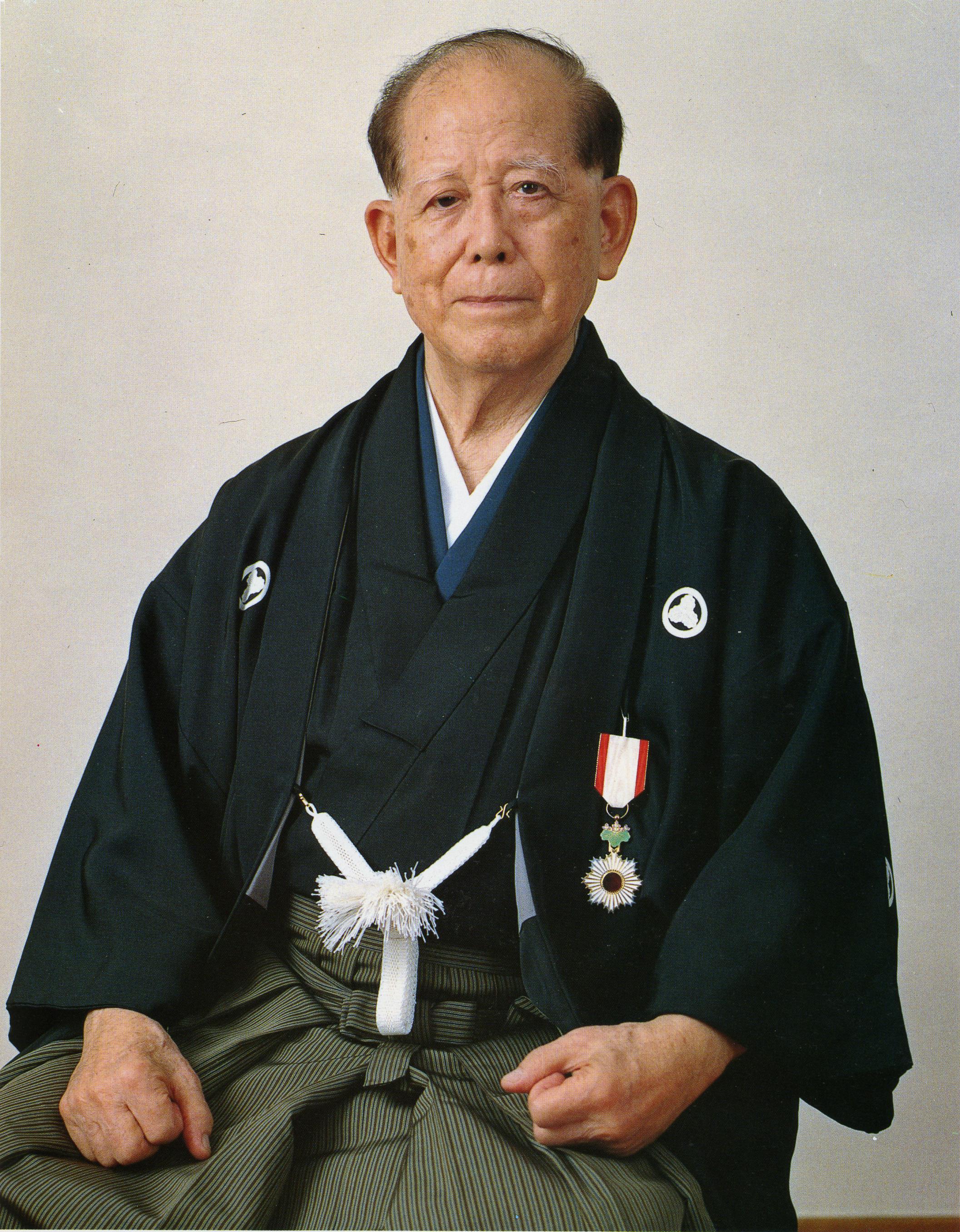
Nagamine was born in Tomari, in Naha City, Okinawa. He was a small and sickly child, and he contracted a gastroenteric disorder in 1926, his second year of high school. He began a self-imposed diet and took up karate under the watchful eye of his next-door neighbour, Chojin Kuba. Nagamine soon became a picture of good health, crediting his recovery to "hard work both at school and training of Karate. His health improved to such an extent that he became a leader of the school's karate club, and his friends dubbed him Chaippaii Matsu, a nickname meaning "tenaciouspine tree".
After graduation in March 1928, he began to study martial arts full time, moving to Shuri and training under Taro Shimabuku (島袋善良)and Ankichi Arakaki. Later that year, he was conscripted into the Japanese army in the 47th Infantry Division, and fought in China before receiving an honourable discharge in 1931. Leaving the army, Nagamine sought an area in which his martial arts abilities would be useful, eventually settling on the police force.
During his time as a police officer, Nagamine received further instruction in karate from Chotoku Kyan and Motobu Choki, and achieved the title of Renshi in 1940. By 1951, Nagamine was aPolice Superintendent, of Motobu, and was training his own officers in karate. Nagamine retired as a policeman in 1952, and in 1953 he returned to Naha City and set up his own dojo, which he named "Matsubayashi-Ryu Kododan Karate and Ancient Martial Arts Studies". From the dojo he taught Matsubayashi-ryu, a karate school he had invented in 1947, and named in honour of Sokon Matsumura and Kosaku Matsumora. He continued to teach the discipline until his death in 1997. He was succeeded by his son, Takayoshi Nagamine, who is now the current sōke of Matsubayashi-ryu.
Subscribe to our official newsletter for tournament announcements, technical insights, and exclusive federation updates.
